
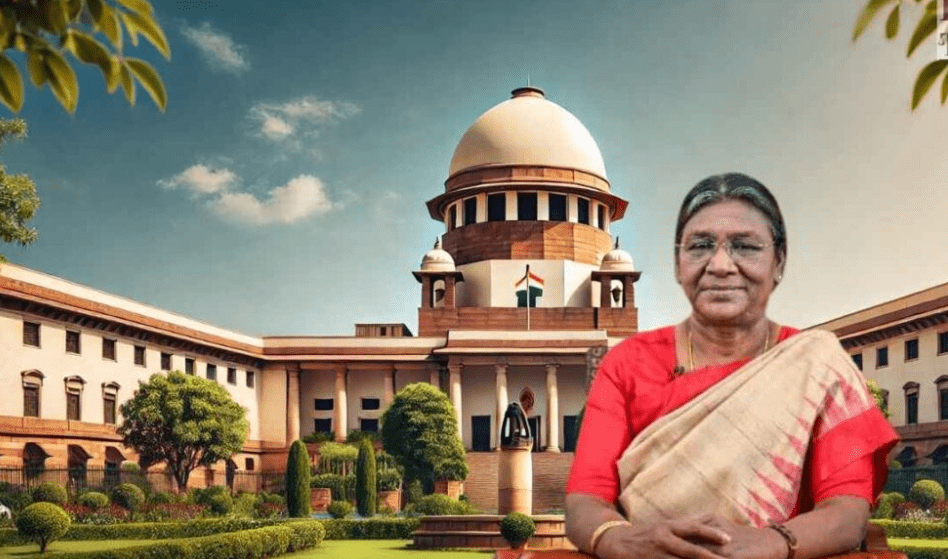
President Droupadi Murmu has invoked Article 143 to seek the Supreme Court’s opinion on delays by governors in passing bills, a move that could have significant implications for center-state relations.
In a historic and constitutionally significant move, President Droupadi Murmu has invoked Article 143 of the Indian Constitution, seeking the Supreme Court’s advisory opinion on an increasingly contentious issue: delays by Governors in granting assent to bills passed by state legislatures.
This move, though rare, brings the spotlight back on the ongoing friction between state governments and governors — a long-debated aspect of Indian federalism.
🏛️ What Is Article 143?
Article 143 of the Indian Constitution empowers the President of India to seek the opinion of the Supreme Court on questions of law or fact of public importance. While the Supreme Court’s response is advisory in nature, it holds considerable moral and legal weight.
🔍 The Issue at Hand
Several state governments have, over the past few years, expressed serious concerns about undue delays by Governors in giving assent to bills. In some cases, important legislation affecting education, public administration, and welfare schemes has been held up for months without explanation.
States such as Tamil Nadu, Kerala, Telangana, and Punjab have raised complaints about their respective governors allegedly acting in a partisan or obstructive manner.
🧾 Why This Matters
- Federal Integrity: The move raises a crucial debate about the balance of power between the central and state governments in a quasi-federal setup.
- Democratic Functioning: Delays in assent can stall state-level governance and reforms, thereby impacting public welfare and development.
- Judicial Interpretation: The Supreme Court’s opinion may clarify constitutional limits on a governor’s discretion and timeframes for action.
📜 Previous Related Judgments
The Supreme Court has, in past rulings, emphasized that governors must act on the aid and advice of the Council of Ministers and cannot function with unlimited discretion. However, the exact timeline or manner in which a governor must act remains ambiguous — hence the relevance of this new reference.
⚖️ Possible Outcomes
- Clear Guidelines: The Court may lay down a specific timeframe for governors to act on bills.
- Limiting Discretion: The advisory may curtail misuse of discretionary powers by governors.
- Stronger State Autonomy: A favorable opinion could strengthen state governments and reinforce their legislative independence.
📢 Political Reactions
- Opposition parties have welcomed the President’s move as a step toward accountability and federal fairness.
- Legal experts see this as a pivotal moment that could redefine Centre-State relations in India.
- Some ruling party leaders have expressed concern that the debate is being politicized for electoral gain.
📅 What Happens Next?
The Supreme Court will now consider the President’s request and deliver an advisory opinion after a detailed hearing. While not binding, the opinion will carry substantial constitutional significance and may influence future legislative and executive actions.
📝 Conclusion
President Murmu’s decision to invoke Article 143 marks a bold and necessary step in addressing a long-standing grey area in India’s constitutional framework. As India continues to evolve as a robust democracy, such interventions strengthen the democratic ethos by reinforcing the rule of law and cooperative federalism.
Tags: #GovernorDelay #SupremeCourt #Article143 #IndianConstitution #Federalism #DroupadiMurmu #IndianPolitics #StateGovernance #LegalNews